
Before most can drive a car
Overall KSI rate: 37.4
Young driver statistics
Official data reveals a short, important window when road casualty risk rises sharply and preparation can begin before young people face those decisions alone.
Understand the changeRisk by age
The pattern is not a single jump and return. It rises before and during the transition to driving, reaches its population-level peak at 18 and remains elevated through the early twenties.
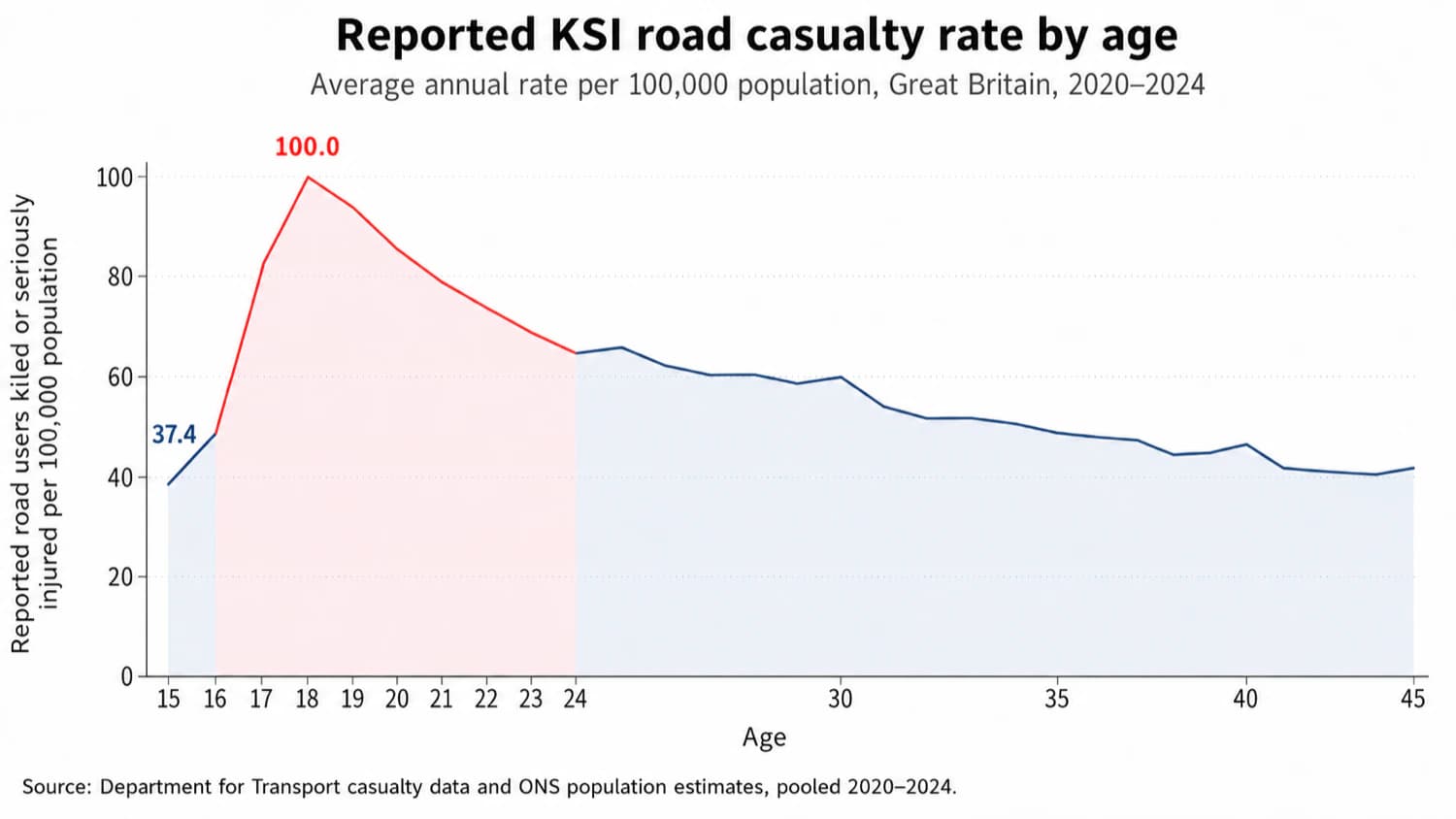
Overall KSI rate: 37.4
Overall KSI rate: 100.0
The rate declines, but remains above age 15.
Read the chart carefully. It includes every road-user type, not licence status. Separate novice-driver research finds collision risk is highest immediately after licensing and falls as experience builds.
The imbalance
The figures below compare their share of Great Britain's licence holders with their involvement in fatal and serious collisions during 2024.
were aged 17 to 24
involved a driver aged 17 to 24
Young drivers are involved in the most serious collisions far more often than their share of licence holders would suggest. That imbalance is the warning.
Source: Department for Transport, minimum learning period consultation, 2026.
Who else is harmed
More than half of those killed or seriously injured were not the younger driver or a passenger in their car. They were other people sharing the road.
people killed
people killed or seriously injured
Who were the 4,735 people?
Source: Department for Transport, Younger Driver Factsheet 2025.
Where the risk concentrates
Police records and post-test research repeatedly point to speed, inexperience, rural roads, single-vehicle collisions and the first months after passing. Choose a view to see what each pattern reveals.
Police records, 2024 to 2025
Ineffective observation was recorded equally. The difference widens around speed, driving for the conditions and inexperience.
More than one factor can be recorded. These are police officers' initial assessments and do not, by themselves, establish the cause of a collision.
of KSI casualties in younger-driver collisions occurred on rural roads, compared with 42% for other-aged drivers.
of younger car driver KSI casualties in 2025 occurred in a collision involving no other vehicle.
of younger car drivers involved in KSI collisions were recorded as not wearing a seatbelt, compared with 10% across all ages.
KSI casualties in younger-driver collisions peak during these hours. Their share of car collisions is highest late at night and early in the morning.
Mileage-adjusted casualty rate, 2025
For every billion miles driven, male car drivers aged 17 to 24 were around four times as likely to be killed or seriously injured as all car drivers aged 25 or over.
Killed or seriously injured driver casualty rate per billion miles
This Department for Transport comparison accounts for distance driven. It describes the casualty rate for drivers themselves, rather than all casualties in collisions involving younger drivers.
A Great Britain study of more than 2,500 test passers
Around one in eleven participants self-reported a collision of some kind during their first six months of independent driving. Most were damage-only collisions.
The study also found that being younger at test pass and driving more were associated with increased collision risk.
Sources: Department for Transport, Younger Driver Factsheet 2025 and DVSA and TRL, Transforming the Practical Driving Test.
A worldwide challenge
Learning and licensing differ across Europe, yet young drivers remain over-represented. The common pressures are developing judgement and limited experience at the start of independent driving.
Different routes to independent driving
Independent driving follows the test.
Supervised driving takes place before the final test.
Under-18s can drive with an experienced adult after passing the test.
of car drivers were aged 18 to 24
2016of car drivers killed were under 25
2015 to 2019Impulse control, weighing consequences and resistance to social pressure continue developing through the teenage years.
Hazard perception, anticipating unfamiliar situations and judging personal limits all strengthen through practice.
The practical lesson: a driving test can assess whether someone meets the required standard on the day, but it cannot remove the effects of age or create experience. Preparation needs to start earlier and continue over time.
Source: European Road Safety Observatory, Novice Drivers thematic report.
What can change
International evidence shows that novice-driver risk is not fixed. Gradual exposure through practice gives new drivers time to build experience before facing every driving condition alone.
Reductions were found across every graduated licensing system studied, although the size varied.
Read the reviewThe government consulted on a minimum learning period, supervised hours and a structured learning syllabus.
Read the consultationA window to act
A driving test cannot create experience. Without structured preparation, young people are often left to build judgement after they begin driving alone, during the period when novice-driver risk is highest.
DriverReady makes use of that earlier window. Over six weeks in school, teachers guide students aged 14 to 17 through the decisions they will soon face. Students understand why dangerous situations develop, practise strategies for decision-making and peer pressure, learn how to share the road safely, and make personal plans for situations they may later face independently. Experience will still matter, but those situations do not have to be the first time they have considered what to do.